
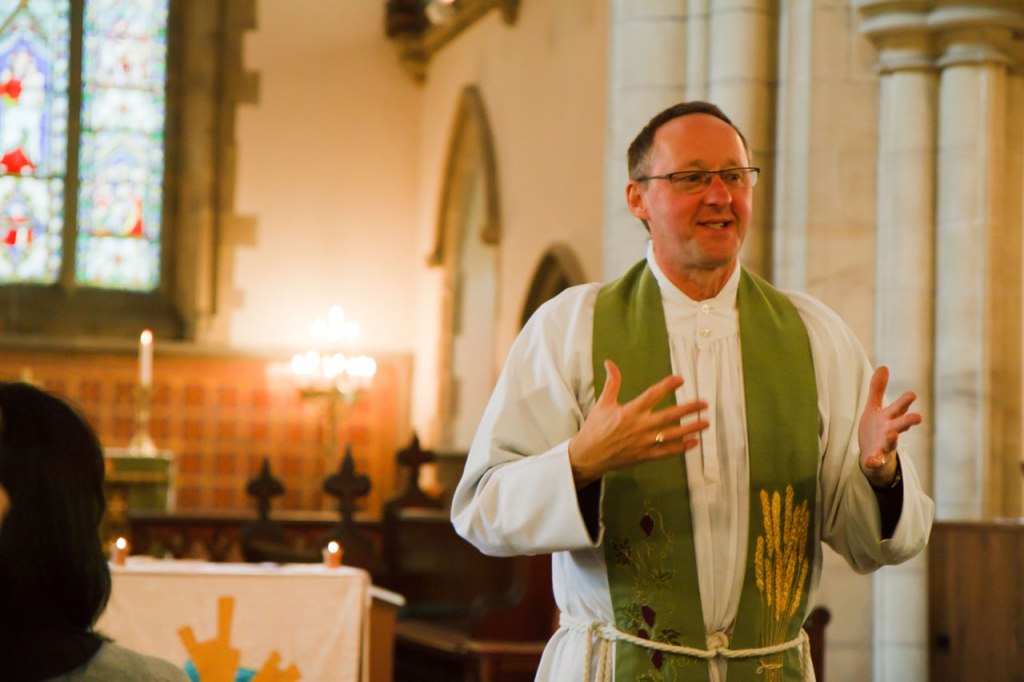
“To conclude this sermon, today I implore all of you to listen to the Holy Spirit in your lives. You need to pray to seek God, tune your ears to hear him, and make space in your heart for God to enter”.
Does this sermon ending ring a bell to you? Maybe not word-for-word, but I can bet that countless preachers have ended their sermon with one of these phrases:
- “Listen to the Holy Spirit”
- “Make space for God”
- “Understand the truth” (or some other concept like a spiritual reality, Jesus’s return etc.)
- “Put Jesus at the center of your life” etc.
Accompanied by countless dispassionate, blank nods around you, what’s wrong with such advice?
Here’s my hot take in this post – I think a lot of such Christian speak is vacuous and pointless. Let me explain why.
Preaching and teaching are very similar
If you are a regular church attendee, consider why we as a body of Christ gather to hear our pastors preach every Sunday. Is it simply to hear the will of God? Surely it goes beyond listening and comprehension. Is it to offer new perspective to Scripture? Maybe, but why is that important?
I would offer this simple catch-all answer: the end goal of coming to church and hearing a good sermon is to transform our lives. No matter what the contents of the sermon are, or how the preaching is delivered, every pastor worth their salt hopes that after his/her sermon concludes, every attendee walks out of the church doors slightly different from when they came in. Some might feel challenged, some encouraged and some inspired to correct an aspect in their lives, but the end point is that there should be some concrete change in one’s routine, behaviors and/or inclinations.
“Do not be conformed to this age, but be transformed by the renewing of the mind, so that you may discern what is the will of God—what is good and acceptable and perfect. (Romans 12:2 NRSVUE)
Taking a step back, this is not much different from how a teacher instructs a student. Essentially, a preacher in a sermon is equivalent to a teacher to an audience of church attendees. In pedagogy, teachers are routinely taught how to construct proper learning outcomes for students. One of the key rules when crafting learning outcomes is to use “actionable” verbs that clearly outline what a student should be able to do with his/her newfound knowledge, and how can his/her learning be assessed at the end of a class. For example:
- “Students should understand and appreciate the role of soil characteristics in shaping plant communities” is a terrible learning outcome. How does one assess one’s “understanding” or “appreciation”?
- Meanwhile, “students should be able to describe and explain the essential soil properties that shape plant communities” is a slightly better learning outcome. This is an outcome that is at the very least, demonstrable.
- Even better, “students should be able to communicate which aspects of soil structure and nutrient availability determine plant recruitment and establishment” is a very strong statement, focusing specifically on the processes that students should be able to conceptualize and communicate clearly.
A well-established learning outcome makes it clear what the student ought to be able to do the moment the class ends, and he/she walks out of the classroom. Similarly, a good ending to a sermon should make it equally clear what the audience is called to do once the congregation leaves the building. There needs to be an imperative to bring behavioral and attitude change. Without it, sermons become abstract, distant and unactionable to the audience, killing the end goal of transforming lives and making disciples of Christ.
A disciple is not above the teacher, but every disciple who is fully qualified will be like the teacher. (Luke 6:40 NRSVUE)
Below are my specific grievances addressing the specific catchphrases above.
“Listen to the Holy Spirit”
Isn’t this phrase already a “direct” enough instruction? As good and biblical as it sounds, I don’t think most believers hear the call of the Holy Spirit the same way they hear someone talking next to them. The nature of the Holy Spirit is complex, mysterious, enigmatic, yet occasionally personal to people’s faith, making it difficult to relate to Him in direct terms.
Now the Lord came and stood there, calling as before, “Samuel! Samuel!” And Samuel said, “Speak, for your servant is listening.” Then the Lord said to Samuel, “See, I am about to do something in Israel that will make both ears of anyone who hears of it tingle. (1 Samuel 3:10-11 NRSVUE)
If you are one of those lucky few who receive crystal-clear commands from the Holy Spirit like Samuel – good for you (you don’t need to read this)! But for the majority who don’t, consider the following:
- If you do suspect you’re receiving a prompt from the Holy Spirit, how can you tell if it is Him and not your own thoughts manifesting?
- How do you know if it is Him and not some other force, or random pattern matching that people are so inclined to do?
The advice by itself is definitely well-intended; Christians should strive to seek God’s counsel. But exactly how one accomplishes that needs to be communicated less abstractly and more actionably. Consider these instead:
- Take a moment to step back from the hustle and bustle to reconsider what God is trying to convict you towards, based on His teachings, Scripture and personal revelation (if applicable).
- Reflect to test whether the prompting you’ve received is aligned with God’s character and His Will (versus your own inclinations), as ordained in Scripture.
“Make space for God”
Another cliché catchphrase from pastors trying to get their congregations to become “more holy”. Again, this advice is usually well-intended, targeting Christians who have filled their minds and hearts with earthly things at the expense of heavenly ones. But if clearing one’s heart to “make space for God” is the end goal, why not just outright say it that way?
Create in me a clean heart, O God, and put a new and right spirit within me. (Psalms 51:10 NRSVUE)
Consider these imperatives instead, which give believers a better idea what they can do as opposed to focusing on how they should be:
- Have you amassed too much baggage in your lives that distract you from doing God’s Will? Reflect in a quiet space, take stock and devise a course of action to let go of the ones that weigh you down.
- Once you have cleared the baggage and made room in your heart, fill it up with spiritually nourishing stuff. This could mean taking up Bible study and interacting with other like-minded believers to engage yourself with God’s Will on a regular basis.
“Understand the truth” (or some other concept like a spiritual reality, Jesus’s return etc.)
I hear this phrase a fair bit, often coinciding with times when pastors are trying to convey something more abstract or theologically dense (usually while being underprepared in doing so). As shown in the example of learning outcomes in a class above, one should not use terms such as “understand” or “appreciate” to invoke learning and transformation.
A stronger, more useful advice will be dependent on what concept the preacher is trying to convey. Here’s an example:
- <On the topic of spiritual warfare> The threat of spiritual warfare is real, and what’s at stake are your souls. Be careful to guard your heart by choosing your company wisely and test your motivations against Scripture to check if you are being lured astray from God’s Will.
“Put Jesus at the center of your life”
This must be one of the most overused catchphrases among preachers, even if it may be essentially correct. The difficulty comes in the lack of communication on how a Christ-centered life looks like, and the steps believers can take to get there. The end goal is there, but it is hidden by the fog of empty words and vacuous prescriptions. And without the view of the finish line, believers are less likely to engage in radical transformation in thoughts and attitudes.
A slightly better version of this advice is “model your life after Jesus”, but even that can be improved. To be more precise, one may choose to specify more precisely which parts of our lives we can emulate after Jesus. Here’s an example:
- Putting Jesus at the center of Your life means prioritizing what He prioritizes – your will should align with His. The gospels said Jesus often prayed to the Father and brought healing and respite to the sinners and the needy. While not all of us can do miracles like Him, we can all reach out to the needy like Jesus to minister to their needs.
Closing thoughts
These are just some of the thoughts I’ve amassed through sitting through sermons over the years, both good and bad. From my recollection, the sermons that I felt were good stuck because of their conciseness and their clear imperative on what the message meant for us. The bad ones – I could not remember what they said. This was because they did not form an impression on me due to the lack of a clear imperative.
I don’t think the advice in this post here needs to be restricted to the pulpit. As long as you are a fellow believer, anytime you are tempted to produce one of these feels-good catchphrases because “it feels right”, consider whether you can deliver the same statement in a way that is more concrete, actionable and personal. Instead of praying in broad strokes for divine revelations and being filled with the Spirit, consider pondering/reflecting a bit longer to make your request to God more specific and less fuzzy – why do you want these things for? If you are advising a friend to seek God’s counsel, enquire what kind of counsel is he/she looking out for; then suggest a concrete action that he/she can take to seek that counsel.
If words are a blessing from God, then all the more we should cherish them and use them prudently and with discernment! May everyone refine their speech and prayers to better spur each other to be closer to God in clear, actionable ways this Easter!
Let your speech always be gracious, seasoned with salt, so that you may know how you ought to answer everyone. (Colossians 4:6 NRSVUE)





 Forests vs faith
Leave a comment