

Last year, I spent two blog posts covering a book that I read from Dr. Paula Fredriksen, one of the world’s leading experts on early Christianity – a book very ironically yet appropriately named Ancient Christianities (see here and here). In her book, she covers the diversity of Christian theology and practices in the first few hundreds of years of the faith, spanning a period ranging from pre-Jesus era, up to the era of Constantinople that gave birth to the famed Council of Nicea.
In the modern era, many believers today see their faith as the “One True Faith”. Scripture and God are unmovable and unchanging; their interpretation of Scripture and understanding of God is static and consistent thorough the ages, etc.
But is that really true? Ever wondered where would your theology fall within this range of early Christian thought?
Somewhere on Reddit, Oroq (u/OneBenefit4049) created a really interesting Christian denomination quiz as part of a project called TheoCompass, with the goal of using modern data-driven methods to classify one’s theology along the spectra of beliefs and practices encountered in the history of the faith. While it is a tool made just for fun, it was extremely intriguing to see the options presented in this quiz that highlights just how diverse Christianity is. I recommend people give it a go if you have the time (it’s 63 really intense questions long lol).
Here are some of the more thought-provoking questions that I wanted to share here. These are just my own opinions and understanding of the faith, based on what I learnt from nearly a decade of attending church and reading from a diversity of academic and devotional sources. In no particular order:
Nature of God: Which best describes your understanding?
My answer: Jesus is subordinate, a created being, or a great prophet, but not God in the same sense as the Father.
Rationale: Judging solely from the Scriptures alone, I think there is very weak evidence to claim that Jesus was presented as an entity co-equal to God the Father. At best, it is safe to say Jesus is presented as a highly exalted being, far above anything else in Creation (my view). He clearly invokes the Father’s divine authority to conduct His miracles (e.g. Mark 2:1-10), and in fact He is said to be given that authority presumably by an entity more powerful than Himself (e.g. Matthew 28:18, John 17:2). But claiming Jesus is literally the same as God goes even beyond that, and in my opinion yields several odd interpretations in the gospels (e.g. Jesus would be essentially praying to himself in the Garden of Gethsemane).
The Trinitarian portrayal of God has been shown to be an innovation by the church centuries past Jesus’s death – one only gets close to that reading after the conception of homoousion (one essence). I disagree with the traditional interpretation that verses like Matthew 28:19, 1 John 5:7, Philippians 2:6 and John 1:1 indicate that Jesus is of one essence with God the Father, for the reasons below:
- The rendition in 1 John 5:7 of the Father, the Word and the Holy Ghost are “as one” is well-known to be a later interpolation by biblical scholars, such that modern translations usually omit the final clause of the verse. Without it, the verse simply acknowledges the testimony of the Father, Jesus and the Holy Spirit but makes no claim that these three are of the same essence.
- A similar argument can be made for Matthew 28:19. While the verse does claim that the Father, Son (Jesus) and the Holy Spirit shares “a name”, that simply implies shared divine authority – an uncontroversial theme that existed even in Judaism (see Dr. Dan McClellan’s book on Divine Images).
- John 1:1 is a notoriously hard verse to translate, and most translations approximate the Greek by phrasing “and the Word was God”. The technical details of translating this verse are difficult to follow, but I am inclined to think a better translation would be “and the Word was divine”. Supporting such a view would be how Jesus was later bestowed authority from the Father – a theme throughout the gospel of John which suggests Jesus was subordinate to the Father. I am also less inclined to believe John 1:1 was something Jesus Himself taught, since no other gospel mentions it.
- Finally, what does Paul mean in Philippians 2:6, where Jesus assumed a “form of God”? Possible interpretations argued by scholars include Jesus was a divine entity, perhaps like an angel. Regardless, three verses down, Paul writes that God exalted him even more highly, suggesting that Jesus did not initially possess the highest authority equivalent to that of the Father.
There are three that testify the Spirit and the water and the blood, and these three agree. (1 John 5:7-8 NRSVUE)
Go therefore and make disciples of all nations, baptizing them in the name of the Father and of the Son and of the Holy Spirit. (Matthew 28:19 NRSVUE)
In the beginning was the Word, and the Word was with God, and the Word was God. (John 1:1 NRSVUE)
…who, though he existed in the form of God, did not regard equality with God as something to be grasped, (Philippians 2:6 NRSVUE)
Nature of Christ: Which best describes your understanding?
My answer: Son of God, divine but created by and subordinate to the Father (Arian-like view).
Rationale: See above for my explanation on why I think Jesus is best thought to be a highly exalted being subordinate to the Father. It is also worth noting that Arianism was a very popular view, and was the primary contending view of the nature of Christ at the Council of Nicea. This isn’t some niche view espoused by fringe cults – it may have well been THE theology of Christianity today had history played out differently.
Your view on the historicity of key biblical miracles (e.g., Virgin Birth of Jesus, physical Resurrection of Jesus, parting of the Red Sea).
My answer: These narratives primarily convey spiritual truths and theological insights, their literal historicity is secondary or open to question.
Rationale: My view on most accounts and stories in Scripture is that they serve to convey theological agendas, not historicity. I don’t see historicity as a requirement for one to follow Christ, but I place a high value on validating the historicity authenticity of Jesus’s teachings and distinguishing them from the words later authors put on Jesus’s lips, even though He may not have actually taught them.
View on Scripture’s Inerrancy/Infallibility
My answer: Inspired human document, valuable for spiritual wisdom, but not inerrant or infallible; subject to critical interpretation and discernment.
Rationale: See above. Also, my first ever blog post on the theology track also covers the presence of forgeries in the New Testament, aligning with my personal view that the Bible is a very human book.
Preferred Biblical Interpretation Method
My answer: Focus on original authorial intent, literal meaning unless genre dictates otherwise, historical context. This is the most reliable method.
Rationale: My personal approach to the massive range of literature in the Bible is to consider each author’s intents and perspectives independently of the others. This means no reading John into Mark, no reading Jesus into Genesis, nor assuming univocality from the OT to the NT. I think this approach gives the most honest insight into the theological development of our forefathers without committing the fallacy of anachronism, which a lot of devotional approaches fall prey to.
How is a person saved (Soteriology)?
My answer: Through faith in Jesus as Messiah, repentance, and often baptism, as part of the covenant community, potentially including Torah observance.
Rationale: I covered in previous posts (here and here) why I think Jesus probably did not teach sola fide – justification by faith alone. This was the best answer that I could select that reflected my belief that the historical Jesus likely called strongly for repentance as opposed to belief in Him (Mark 1:15, Matthew 3:2 and Luke 5:32).
Primary emphasis of Christ’s Atonement
My answer: Christ’s death was a ransom paid (variously to Satan or God) to redeem humanity from bondage to sin and death.
Rationale: This was one of the questions I am still undecided. Biblical scholars have proposed that Luke, unlike the other gospels, does not view Jesus’s death as an atonement but a miscarriage of justice instead. Which view is historical – Jesus’s death as an atonement or a martyrdom? I’m not well-informed enough to make a decision on this, and I’m willing to change my mind if someone can argue why Luke’s understanding of Jesus as an occasion for forgiveness is more likely to be historical.
What is your view on Original Sin?
My answer: The concept of ‘Original Sin’ as inherited guilt is problematic or a misunderstanding; focus is on systemic sin, human fallibility, or overcoming error.
Rationale: I personally care very little about the idea of original/inherited sin as interpreted from Genesis. To that end, practically, it is sufficient for the modern believer to recognize his/her transgressions and fallen state, and to work towards aligning their hearts and deeds with God’s Will.
What is your view on Assurance of Salvation?
My answer: Focus on the journey/relationship: Emphasis is on present trust and ethical living, rather than a specific state of ‘assurance’ about the future.
Rationale: Often, I think being too assured with one’s salvation can lead one to complacency and arrogance, often to the point of hurting others (see Matthew 7:21-23 for a warning on self-deception). See my previous post on sola fide for why I think no one can be fully assured of their salvation.
“Not everyone who says to me, ‘Lord, Lord,’ will enter the kingdom of heaven, but only the one who does the will of my Father in heaven. On that day many will say to me, ‘Lord, Lord, did we not prophesy in your name, and cast out demons in your name, and do many mighty works in your name?’ Then I will declare to them, ‘I never knew you; go away from me, you who behave lawlessly.’ (Matthew 7:21-23 NRSVUE)
Stance on LGBTQ+ inclusion (e.g., marriage, ordination)
My answer: Affirming: Full inclusion, marriage equality, and ordination of LGBTQ+ individuals. Orientation and relationships affirmed.
Rationale: I do not worship in such a denomination, but I don’t see sufficient evidence in the NT that explicitly condemns LGBTQ+ relationships because the concept that a faithful romantic relationship could be anything but a man and a woman is unfathomable back then. While I believe the OT actually forbids such relationships, the Torah also bans shellfish; yet I don’t know any believers who abstain from shrimp (other than those who’re allergic) …
Emphasis on Social Justice / Social Gospel
My answer: Social Justice is integral to the Gospel; the Church must actively work for systemic change, advocate for the marginalized, and address societal evils as a primary mission.
Rationale: It bewilders me to think otherwise, considering SO MUCH of the Bible espouses justice, mercy and compassion for the needy. In my view, anyone who answers otherwise should read and re-read Matthew 25:31-46. At the same time, I admit I can and very well should do so much more to contribute towards social justice myself. This is one of the burdens I feel most strongly about regularly.
Women’s Ordination/Leadership Roles
My answer: Women can and should serve in all leadership roles, including pastor, elder, priest, bishop, based on gifting and calling. This is a matter of equality.
Rationale: Critical bible scholars largely agree that the pastoral epistles are forgeries in Paul’s name, and 1 Corinthians 14:34 is likely a later interpolation too. Furthermore, there have been episodes of Paul in Romans 16 naming women as prominent coworkers in Christ, such as Phoebe (a deacon) and Junia (an apostle). To that end, I fail to see any good reason why believers should not capitalize on the talents of half of our population to build the church.
Environmental Stewardship (Creation Care)
My answer: Strong emphasis: Creation care is a core Christian responsibility, integral to faith and justice, requiring active efforts to protect and restore the environment.
Rationale: See my post from last year on this topic.
View on Zionism and the modern State of Israel
My answer: Critical of modern Israel’s policies, particularly regarding Palestinians; emphasizes justice and human rights for all in the region. Church replaces Israel in God’s plan (Replacement Theology) or focus on Palestinian Christians.
Rationale: Even if one believes Israel has a special place in God’s divine plan, claiming that this plan should take precedence over the lives of those in Gaza strikes me as especially cold-hearted. At the moment of writing, more than 70,000 Palestinians have lost their lives for the sake of this so-called “divine plan”. This needs to stop.
How do you interpret biblical passages that mention or regulate slavery?
My answer: These passages are difficult and require careful historical and cultural interpretation. My church may not have a definitive stance, or it’s a matter of ongoing study.
Rationale: I would have preferred to answer differently – the Bible clearly accepts slavery as the norm, and even encourages it in some places. This is one of the reasons why I view the Bible as primarily a product of human inspiration, building on our forefathers’ (perceived) interactions with God. This alone doesn’t invalidate the usefulness of Scripture – it simply means through self-reflection and modern study, we can learn from history and do better today.
Stance on Abortion
My answer: Nuanced/Middle Ground: Life is sacred, and abortion is a serious moral concern, but there may be exceptional circumstances where it could be permissible (e.g., life of mother, severe fetal abnormalities, rape/incest).
Rationale: While I fully agree that life is sacred enough that abortion must not be trivialized, I feel respecting the sanctity of life demands respecting the sanctity of the entirety of one’s life for both mother and fetus, and not just at birth or conception. Hence, I think there remains a lot of room to debate whether abortion is permissible when a fetus has severely genetic abnormalities or when the mother was impregnated out of rape, if there is a strong risk of a poor quality of life for the resulting baby.
Final Results
Here’s my final score! No surprises there…
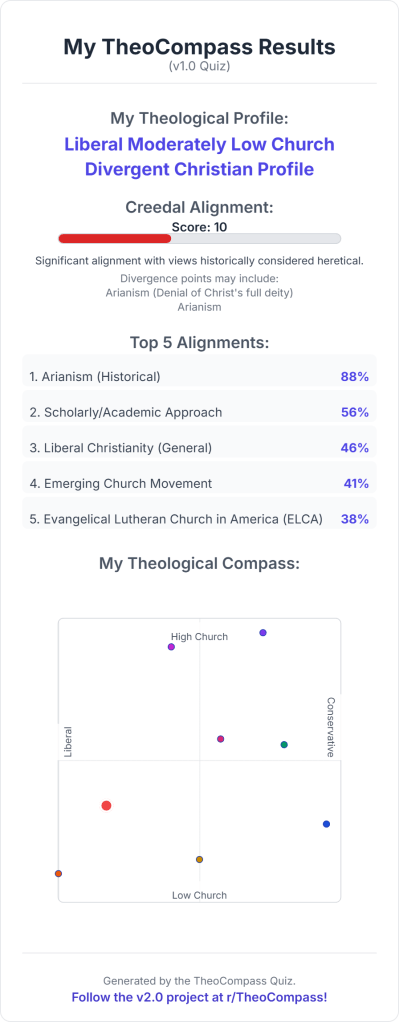
Feel free to let me know how you fared (before you set me on fire at the stake for heresy)!








Leave a Reply