
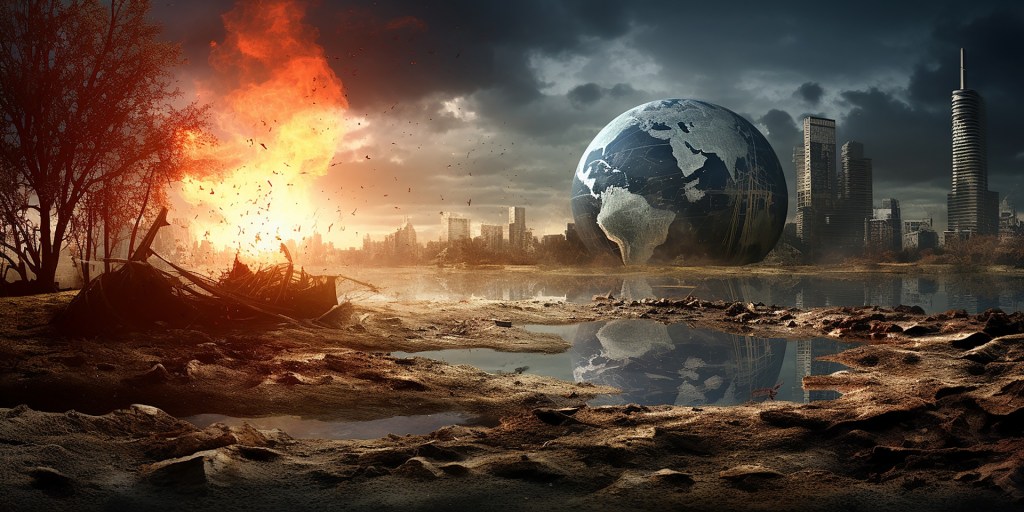
In the spirit of the other posts that I have been writing regarding Creation Care, environmental science and eschatology (the theology of the end times) recently, it only seems fitting to dedicate my next post to the secular version of doomsday – aka the year 2050.
As much as the media wants to hype the doomsday scenario in 2050, it was surprisingly hard to find representative, balanced portrayals on what experts have to say regarding the fate of our world 25 years from now. The media is rife with all sorts of views, ranging from the extinction of humanity to complete skepticism and/or apathy. For the average layman who isn’t accustomed to parsing through the nuances of research findings, piecing together a balanced narrative on what the science says (or doesn’t!) becomes an exercise in frustration.
For this post, I wanted to go through an array of articles that span across the doomsday pessimism spectrum to get a balanced view. On a broader level, I think it is also a good exercise for all readers to reflect on how scientific communication is done in the media space, and the importance of reading original sources that news outlets cite to verify if said news are being overdramatized.
Onto the meat. Just how bad is it?
The “It’s all over!” end
The most pessimistic article that I could find online was written by David Spratt and Ian Dunlop from Breakthrough – National Centre for Climate Restoration, an Australian think-tank on climate-change related issues. In a number of articles published through the same organization, the authors highlighted how “climate change is an existential risk that could abruptly end human civilization…”. Delving deeper into these articles, the authors proposed the following mechanisms that could undo humanity (or strongly curtail its potential) altogether:
- A worsening of the destabilizing effects on the climate due to positive feedback loops on permafrost, oceanic and terrestrial carbon sinks.
- Large-scale societal impacts such as climate change-induced dislocation, migration and cross-border conflicts.
- Threats to basic resources and industrial sectors that support the human race; in particular the availability of fresh water and agriculture.
- The under-preparedness of society to respond to natural hazards such as hurricanes, inclement weather and heatwaves.
- Worsening of regional and global conflict over the issues related above.
I’m no climate scientist, so I am in no position to critique Point 1 on whether these positive feedback loops are as bad as they are portrayed (although I think there’s some truth to that based on current evidence). Points 2-4 seem to be true given recent news events (see here, here, along with the case studies cited by the authors). What I am skeptical about is whether these issues above would lead to an escalation of conflict to the point where humanity (nearly) wipes itself out (Point 5). To the authors’ credit, they pointed towards several case studies from Mali, Sahel, Nigeria and Iraq that shows how drought and desertification has the potential to destabilize entire nations by reducing citizens’ access to resources, fueling discontentment and conflict. From my understanding of these case studies, it would seem like these extreme events have the potential to become an instigator of conflict that causes societies to collapse upon themselves, as opposed to being the actual drivers of ruin itself. Pretty scary stuff.
Subsequently, the authors laid out several scenarios that might play out depending on how the climate crisis develops. Some of these examples include the following:
- Important coastal/low-lying cities being inundated as sea-level rise accelerates.
- Economies collapsing as nations become incapable of coping with the frequency and magnitude of floods, storm surges and droughts.
- Armed conflict (possibly a nuclear war) if countries choose to go to war over basic resources (the author cites the Nile river as a potential hotspot of conflict).
While I don’t think the authors are maliciously overdramatizing these scenarios, one important caveat to note that these are scenarios, not projections. There exists no way today for us to forecast whether Egypt would truly go to war over the Nile, or whether China’s stock market would collapse due to the sheer frequency of droughts and floods experienced. It is through these scenarios that the authors arrived at their primary take-home message that climate change poses an existential risk to humanity. Unfortunately, I don’t see this being communicated in many “doom-and-gloom” news articles on climate change (see here and here for example).
The “Nah, there’s nothing to worry about” end
At the polar opposite of the article above, there exists climate skeptics that diss these apocalyptic views, ultimately arriving at the conclusion that the threat of climate change is overhyped and of no concern.
To me, this seems to be a false dilemma fallacy (if climate change isn’t world-ending, it’s of no concern). Yet, reaching such a conclusion is absurd, given what we know about the effects of climate change on natural and human systems. Yes, we might not go extinct, but it will be bad. Assuming we are still around by then, I think there is a good case to make that modern life as we know it might be forever changed by then (think massive inflation in prices of goods due to loss of agricultural productivity, forced water rationing due to droughts, lack of housing because the weather is too hot for workers to toil in, etc.).
If so, then why the lack of urgency? This could be due to the distant temporal and spatial nature of climate change, and who it affects most. It is an undebatable, yet unfortunate fact, that most of the worst impacts of climate change will be felt by vulnerable communities far away in less-developed nations who simply won’t be able to afford climate adaptation measures to protect themselves. Think of the nations around the world where droughts (e.g. in Africa) and floods (e.g. in Southeast Asia) hit. If climate change ends up wrecking farms in those regions, the effect felt on developed nations would merely be a tighter pinch on their wallets at the nearest Costco – not the life-or-death stakes as so commonly portrayed by the media. Yet, it will be truly life-or-death for the farmers who rely on a successful crop yield to survive. Furthermore, such effects are being felt now, but it is likely that most people from developed, rich, comfortable nations don’t feel that way. Contrary to how media headlines like to suggest, these effects won’t suddenly be turned on when the clock strikes midnight, 2050. They’re happening right now (probably not to you though!), and they’re gradually eroding the resilience and stability of society as we speak.
Finally, it has been at least two decades since climate scientists have started ringing the alarm bells regarding climate change and its negative effects. While there is good reason why the bells have only grown louder in recent years, surveys have documented that excessive alarmism from the media has only resulted in apocalyptic fatigue. Ironically, the loud alarm bells have started to desensitize people as the climate crisis worsens, causing them to disengage from the issue altogether. This can’t be good news for a global issue that requires all hands on deck.
Clarifying the catastrophe
As far as I can tell, these two perspectives are largely fringe views on both extremes and they do not represent the majority view in the media. Indeed, most of the media tends to portray climate change as a threat at some level, using words such as “catastrophe”, “collapsing”, “crisis” etc.
Based on these two extreme views, here is my summary of what I think is the consensus view on climate change, taking care to debunk the extreme views espoused above.
- It is virtually certain that climate change will bring about a host of negative impacts on society, ecosystems and biodiversity.
- There is a fringe, hypothetical risk that climate change will instigate future armed conflicts, ultimately escalating into a global extinction threat to humanity. However, this isn’t the consensus view for now, and it remains to be seen whether climate change is the main driver of conflict in those scenarios, given that such scenarios are often coupled by other stronger sociopolitical drivers, such as weak governance and religious fervor.
- Climate change is a concurrent, gradual phenomenon. It is not a one-off event that will trigger a massive die-off in 2050 (sorry rapture enthusiasts!). No such die-offs are expected to occur in 2050 (or in fact, anytime up till then). Any outlets that try to dismiss climate change by pointing to “failed predictions” are shooting at strawmen and should be rejected automatically.
- Because of its graduality, there is still value to limiting atmospheric CO2 levels as best as we can. While we will probably end up missing the mark on 2°C warming altogether, there is always 2.1°C or 2.72°C to strive for. There is no binary on whether we succeed or fail to mitigate climate change.
- At the same time, the above point doesn’t exclude the possibility of tipping points in specific ecosystems, such as in the Amazon and in coral reefs. This is a real phenomenon in nature known as hysteresis (see my previous post on an explanation), and its looming presence necessitates taking action sooner rather than later.
- As apocalyptic as media outlets try to portray the climate issue, the world isn’t going anywhere in 2050. Nor will humanity. What makes climate change truly concerning is its potential to shape modern life in undesirable ways for generations to come, and how woefully underprepared society and governments are when that transition happens.
Unfortunately, I don’t foresee any chance that these points will ever make it into a news article to be read by millions (hence why I chose to write it here instead). The devil is often in the details, and the public doesn’t like details. That is why the media constantly perpetuate catchy, apocalyptic-sounding headlines. Do it too often, and it makes scientists sound like they’re crying wolf. Thus, I am strongly against news outlets that engage in these alarmist tactics.
I also think this has less to do with poor scientific communication, and more to do with society’s declining attention spans and cognitive ability to consider information slowly and deeply. If one actually dives into technical report such as the IPCC, one would find an abundance of terms such as “confidence” or “uncertainty”, which is a far cry from what most people encounter through their favorite news outlet. The antithesis of research is certainty and speed (which the public craves), whereas the enemy of the layman is uncertainty (which scientists swear by). Because of this conflict, complex findings regarding climate change related issues are at risk of being compressed and dumbed down into catchy, alarmist headlines for the public (and a study have shown most don’t read past the headlines either). Perhaps one day there will be a rise of new outlets of information – ones that can marry the interests of both groups.
But until then, I am betting my money that when the clock strikes midnight on Jan 1st, 2051, there will be no shortage of (religious) idiots on Reddit who proclaim “See! We survived 2050! Scientists were wrong about the apocalypse again…”





 Forests vs faith
Leave a comment