
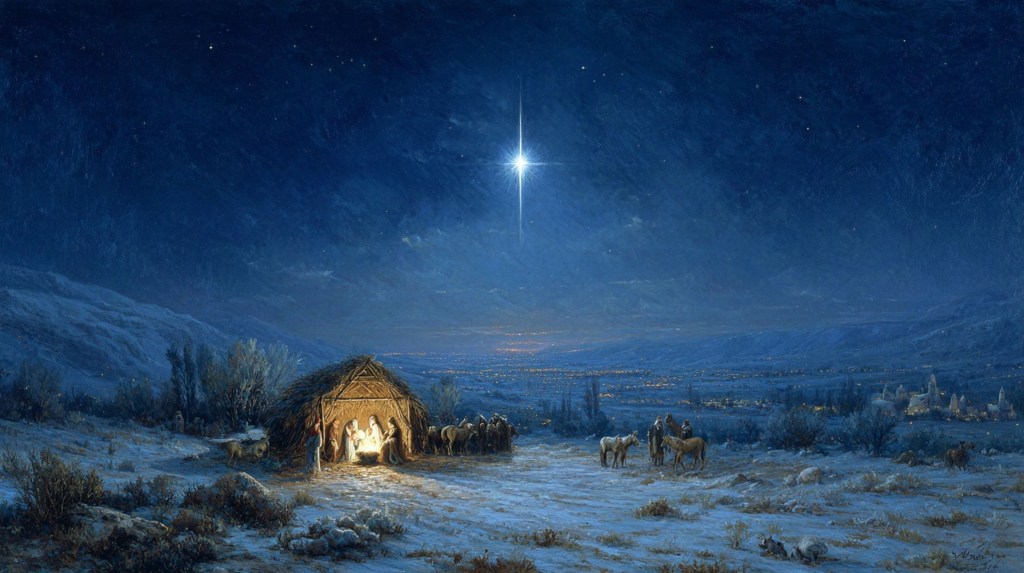
Christmas is my favorite festival of the year. Every year, shopping malls will bring out the shiny Christmas lights, the festive music, maybe some powdered snow and wooden huts – these bring me joy 😊
While my city does not have a Christian majority, many are familiar with the Christmas story in the bible. In that spirit, some malls and churches will enact the scene of the nativity, often by putting up sculptures of magi (wiseman) on camels, or a star on top of a wooden manger.
While I appreciate the gesture of enacting one of the most significant scenes in my faith (both historically and theologically), I don’t know of any historical evidence that supports the nativity happened the way it was portrayed. Don’t take my word for it, however. Based on close examinations of the virgin birth stories from critical biblical scholars, it is very unlikely that either nativity scenes described in Matthew and Luke were historically accurate for the following reasons:
- Both Matthew and Luke can’t agree where Jesus was born. Matthew states Joseph and Mary were from Bethlehem, and Mary gave birth to Jesus there (presumably in their own home, since they lived there). Luke states the couple moved from Nazareth to Bethlehem to enrol in an empire-wide census that had no historical attestation or logic, and gave birth to Jesus in a feeding trough because they could not find lodging. Modern historians believe Jesus was most likely born in Nazareth instead, whereas stories of his birth placed His birth in Bethlehem instead as a literacy device to fulfil messianic prophecy.
- Where did Jesus and His parents go after His birth? In Luke, the couple brings the infant Jesus to the temple in Jerusalem in accordance with the Law of Moses before returning to Nazareth (north of Jerusalem). But Matthew states flatly that Joseph and Mary fled to Egypt (southwest of Jerusalem) to escape King Herod’s culling (we have no evidence of such an event). Both happening consecutively seems highly improbable considering the geographical distance and reasoning. In Matthew’s account, the journey to Egypt reeks of another literacy device to fulfil prophecy, instead of actual historicity.
- Disregarding the physical impossibility that a star standing stationary over a spot, who were the magi and why were they paying homage to Jesus? The identities of the magi weren’t made clear in Matthew’s story but they appeared to come from “the east” (it is believed they could be Zoroastrian priests, as the term magi is actually used in Persian religions). Regardless, it is clear these men were pagans – why then would they have business worshipping a foreign king? But when one reads the entirety of Matthew, it becomes clear what the author is doing – the gentiles are portrayed to worship Jesus, whereas the Jews and kings want Him dead instead.
Of course, there is no lack of attempts by Christians to reconcile all the events described between Matthew’s and Luke’s accounts of the nativity. They are free to do that, of course, but I don’t see much merit in jamming round pieces through square holes for the sake of historicity. Rather, by examining each author’s account independently, one can better understand about what each author thought of Jesus and His opponents, and how that played into His ministry, life and death.
Is historicity all that important?
Thinking about the nativity made me ponder a different question – one that involves not just the Christmas story, but all the miraculous stories and legends throughout the bible. Does faith demand historicity? Do we require these events to be historically accurate to believe?
On the surface, the instinctive answer is an obvious yes. For most believers, of course it must have happened as it was written in the bible! Otherwise, our faith is baked on a series of fairy tales!
Now if Christ is proclaimed as raised from the dead, how can some of you say there is no resurrection of the dead? If there is no resurrection of the dead, then Christ has not been raised, and if Christ has not been raised, then our proclamation is in vain and your faith is in vain. (1 Corinthians 15:12-14 NRSVUE)
Yet, plenty of people today (and in history) do not read major events in the bible as historically true. For example, many educated people in the sciences today do not think that there was literally a great flood. Maybe there was a major exodus from Egypt, but no archaeological records from ancient Egyptian civilization or the desert support the existence of such a large wandering community.
Throughout the history of Christianity, believers sorted out their beliefs with assortments of symbolisms, legends and allegorical readings of Scripture. We know from alternative Christian traditions that some sects thought that His life, ministry and crucifixion were illusionary (see Docetism). St. Origen – a major theologian in the third century – denied a literal interpretation of Genesis. And even till today, not every Christian believes in a literal resurrection of Christ. In fact, if one believes in every event in the bible literally, one is forced to accept some weird stories as factual (remember the zombies in Jerusalem in Matthew 27:50-53?).
Whence also in them were intermingled not a few things by which, the historical order of the narrative being interrupted and broken up, the attention of the reader might be recalled, by the impossibility of the case, to an examination of the inner meaning. But, that our meaning may be ascertained by the facts themselves, let us examine the passages of Scripture. Now who is there, pray, possessed of understanding, that will regard the statement as appropriate, that the first day, and the second, and the third, in which also both evening and morning are mentioned, existed without sun, and moon, and stars — the first day even without a sky? (St. Origen, De Principiis, Book IV, 16)
Clearly, believers across the generations have taken huge liberties as to whether events in Scripture were to be understood as historical truth (versus symbolism, or spiritual truth etc.). Time after time, what has been more important to them isn’t what actually happened, but what to make out of these stories instead. In other words, it was the belief that these stories carried divine meaning that informed the faith, and not the actual occurrences of these events.
Closing thoughts
Back to the story of the nativity.
I don’t think we will ever fully know how much of Jesus’s birth account is historically accurate, and I think it is a fool’s errand to claim absolute certainty that we can know. Nowhere else in antiquity do we find the story of Jesus’s birth, making it very hard to find historical attestation. Furthermore, we know that both Matthew and Luke had their own agendas in telling the nativity. Matthew wants Jesus to be portrayed as the long-awaited messiah of the Jewish people, who ironically was worshipped by gentiles and hated by His own people. Luke wants Jesus to be portrayed as the Son of God who starts off as an infant of humble beginnings; ultimately growing up to fulfil His holy mission to bring people back to God, facilitated by John the Baptist. I don’t see any way we can filter out Matthew’s and Luke’s theological agendas from their accounts to arrive at what really happened, other than a few common elements.
At the same time, one does not need to verify historicity to appreciate the Nativity. To some, the humble beginnings of Jesus in a manger reminds them that Jesus humbled Himself to give us new life. To others, seeing how the infant Jesus worshipped by the magi and anointed by the star can remind them of His majesty and sovereignty. Regardless of which version of the story you believe, clearly Jesus is portrayed as someone special. At least, special enough to become the figurehead of the world’s largest religion today.
At the end of the day, as much as apologists try to make historicity a big deal for the average believer, I don’t think historicity matters as much as they think it does. The average believer isn’t going to care about the historical methods to prove the gospel accounts true; they’re going to look at stories such as the nativity and draw inspiration from them, whether or not it happened that way. The same goes for pretty much any story in the bible, be it the Creation account, the exodus and redemption of an entire people, or any miraculous healings. In a modern world plagued with troubles and rife, sometimes a little hope is all they need.
Merry Christmas and may the Lord’s favor be upon all this holiday season!





 Forests vs faith
Leave a comment