
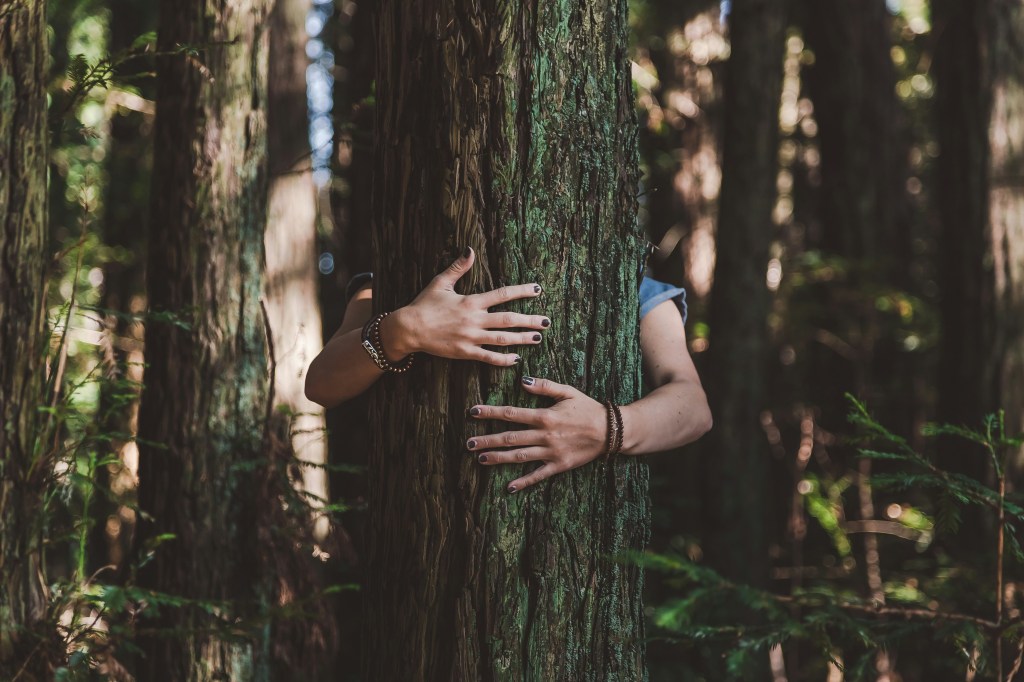
As an ecologist, one of the main perks of my job is being able to go outside and immerse myself in nature on a regular basis. Because I study plants, I would regularly find myself in a tropical forest surrounded by dozens of species big and small, hearing the birds sing over my head and listening to the whispers of the forest as the leaves rustle to the wind. What a blessing.
I am certainly not alone in this. The benefits of nature immersion are real and well-documented, and many people today find solace while roaming through natural spaces. If you are from a temperate region, every weekend you can find cyclists and runners darting between spruce trees, sometimes accompanied by friendly, enthusiastic canines. If you are from my part of the world, you’ll regularly encounter white tourists braving through the humidity and heat to wander through a tropical forest, or to climb a peak to access a splendid view. There is just something rewarding and refreshing about going outdoors into Mother Nature, so much that society pays billions of dollars into ecotourism and exploring nature spaces annually.
At the same time, coming from a city, I do know of many urban friends who do not share quite the same enthusiasm for nature as I do. Many would grimace when I pick up random litter or critters from the forest, and even less would appreciate the messy, chaotic state of a tropical forest understory. Some mildly panic when they hear that snakes and spiders roam freely in the forest. To put it in Gen Z speak, some of us are just built differently…
In a typical urban landscape, nature often comes at a premium, and it competes with other land use priorities (residential, energy, roads, etc.). From my experience, very few will be convicted of conserving forests for their intrinsic sake, or for the sake of biodiversity, or for ecosystem services whose benefits can barely be perceived. Unless we can somehow show how we stand to gain from preserving forests, few will bat an eyelid to the battle between natural forests and urban development. And safe to say, one of them loses more often than the other…
But perhaps there is a way to demonstrate that forests do have a generalizable benefit to us, regardless of one’s inclinations towards nature? That is what I want to explore in this post today.
The psychological benefits of forests
Ever since the 20th century, researchers have reported numerous psychological rewards from exposure to natural spaces such as forests, ranging from empowerment, sense of liberation, enhanced spirituality – the list goes on. Because the psychological rewards from wilderness are so strong and alluring, there has been no shortage of efforts made to capitalize on said effects – think eco-tourism, wellness therapies, etc.
While no one really questions whether these psychological benefits exist, a more pertinent question to ask is how generalizable these benefits are, and how specific to forests they are. For example, just because a city-dweller finds respite from escaping to a wooden log cabin in the middle of a pine forest, it doesn’t mean that the environment itself is responsible for said benefit. Distinguishing between the direct effect of the forest versus the effect from escaping stressful urban life is essential to diagnose whether said forests are a source of respite and comfort, or simply a result of leaving a stressful environment.
This distinction matters more than you may think! Put yourself in the shoes of an urban planner working for a government agency, deciding the fate of a patch of pristine forest in the middle of a busy urban landscape. In the former scenario, there is a much stronger incentive to leave the forest as it is, or to convert it into a protected green zone, so that residents can continue reaping psychological benefits from the nature space. In the latter, the green space is substitutable for other land uses, so long as it provides a contrast to the overall stressful urban environments – think ornamental gardens, no-car zones, etc. However, only in the former case is local biodiversity most likely conserved.
Because it is difficult to untangle whether forests (or other equivalent natural pristine landscapes) are the source of psychological benefits to people, a few researchers have started considering instead whether exposure to pristine natural forests can benefit us physiologically. In layman terms: can forest exposure be good for our bodies, not just our minds?
The physiological perspective
Finding studies that document physiological benefits for nature exposure isn’t difficult. However, finding a paper that describes a clinical mechanism for said benefits was surprisingly hard, and most research is still stuck at the descriptive stage in this research field.
At this point, I could find only a handful of studies explicitly highlighting mechanisms that clearly show how forest exposure can be healthy for us. One researcher spearheading this research is Dr. Qing Li from Nippon Medical School in Japan, who proposed that trees emit volatile organic compounds (VOCs) known as phytocides. These compounds stimulate natural killer (NK) cell activity in the body, boosting one’s immune function. If you are familiar with how essential oils work, a forest acts as a giant reservoir of essential oils permeating through the air, stimulating our immune systems naturally*. Even so, these findings were found on field experiments with modest sample sizes (typical of many clinical studies), and they have yet to confirm whether these effects are generalizable to all populations, all trees species, or at all durations of exposure. However, should further studies confirm the efficacy of said effect, this could point towards a real health benefit forest exposure has on urban residents.
*Anecdotally, I do find myself falling sick less often during fieldwork season. For the record, I haven’t fallen sick this year (yet) – maybe all that fieldwork is doing something…
In addition, researchers have also proposed forests may capture particulate matter (PM) in the air that are responsible for a host of health problems in urban spaces. Residents who spend a significant amount of time in forests may, quite literally, enjoy “clean air” as plants intercept PM from urban air pollution (cars, ozone, aerosols etc.) before they enter one’s lungs. Independent research has confirmed that these PM particles do negatively influence health by promoting inflammation and respiratory infection. What remains unknown is how persistent these benefits are once individuals leave the forest, and whether a typical recreational visit is long enough to produce meaningful health effects in individuals.
Forests could be doing so much more for us than we realize
Forest ecosystems supply a large range of ecosystem services, ranging from storing carbon, rainwater interception to recreation and tourism. Despite their utility, many of these services remain unperceivable (e.g. carbon sequestration) or selectively applicable to a minority (e.g. tourists). As harsh as it may seem, forest conservation is and will be prioritized only when a majority of politicians and the public perceive its benefits to be significant enough to be worth investing.
That is why personally, I am looking forward to seeing future developments in this field to unravel other physiological benefits forests may have on people. Perhaps someday, we can definitively, conclusively prove that everyone should go out into a forest because it is good for our health. MAYBE then politicians will start taking our forests a bit more seriously and commit to forest conservation.
For the rest of us – perhaps consider going to your backyard forest to hug a tree today! Maybe it’ll do you some good…






Leave a Reply