
In the 20th century, a beautiful, large woodpecker was roaming the forests of Southern US and Cuba. In those times, the Ivory-billed woodpecker (Campephilus principalis) was the largest woodpecker species in the US; yet like many species before it, habitat destruction caused its population to tumble. By around 1956, it was presumed to have gone extinct…or did it?
Sightings of birds that looked like the ivory-billed woodpecker have persisted since, even till today. The last accepted sighting of the glorious bird was reported from Cuba in 1987, and even those records were hotly debated. In the early 2000s, a number of sightings that appeared to be the enigmatic bird were reported, compiled and published by Dr. John Fitzpatrick, who strongly asserted in his paper that the ivory-billed woodpecker continues to live. As recently as 2023, Dr. Steven Latta added to the debate of the fate of the ivory-billed woodpecker by publishing a study containing an impressive compilation of (really blur) photographs, acoustic records and drone flight recordings to back Dr. Fitzpatrick’s assertion. Even then, not many conservationists were convinced, and today the debate rages on – were those sightings really the ivory-billed woodpecker, or something else?
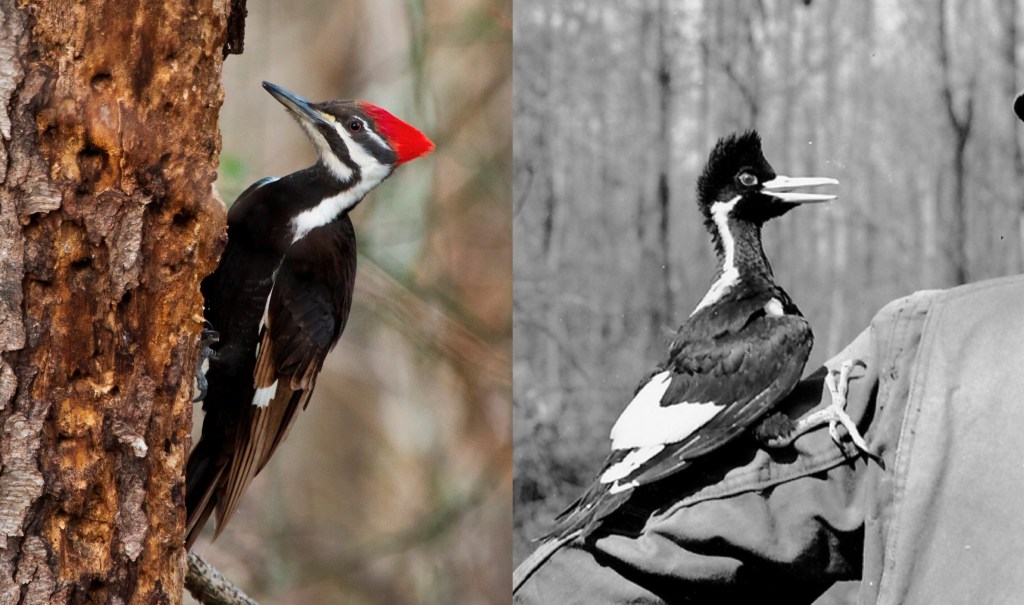
Pileated woodpecker on the left; Ivory-billed woodpecker on the right from a 1935 photograph. Imagine seeing one of these hundreds of metres away hidden within tree canopies – could you tell them apart?
I’m not really a birder, so I never really gave much thought about this spectacle in conservation (though the bird does look cool). What I did find bewildering, however, was just how much fervor, energy and time was devoted to verifying whether the ivory-billed woodpecker was one species or two, and distinguishing the ivory-billed woodpecker from its similar woodpecker cousins. This isn’t an isolated case in biology and conservation. Ever since the advent of DNA analysis, scientists have initiated numerous attempts to rename, distinguish and clarify species classifications ranging from frogs, snakes, jellyfish, and most definitely plants. Even humans are not spared.
But why?
Why pour in all that time, energy and money?
When I first started studying ecology nearly a decade ago, there was one particular field of research that really did not interest me – phylogenetics. Four years later, when I embarked on my PhD, I would sometimes participate in conferences flooded by evolutionary biologists quibbling over whether bacteria X was truly X or Y, or whether lineage Z was monophyletic (a whole lineage derived from a common ancestor). Who cares?!
Now that I am a bit older with more experience in ecology and biological research under my belt, I am starting to see why biologists are so interested in getting the art of phylogeny and species classification right. Here’s why.
For one, the concept of species is a fuzzy one in biology. What makes an ivory-billed woodpecker a different species from a pileated woodpecker, whereas the white and black peppered moths are the same species? Even with modern sequencing technology, there is no hard-and-fast rule that dictates a minimum number of DNA differences for two organisms to count as distinct species. The lines get even fuzzier when one enters the microbial realm, where bacteria regularly exchange DNA with one another, and with the environment. To put it briefly – the very concept of species itself is not something intrinsic to nature; it is a tool that we invented to organize and make sense of the rich biodiversity around us. By putting subsets of organisms into discrete “boxes” known as species, we can start ascribing characteristics to these “boxes”, such as their ecology, their habitats, and their relationships with one another. Exactly how biologists differentiate these boxes has its own problems and deserves its own post, but for this post, it is sufficient to say the species concept enables us to group together and meaningfully characterize organisms sufficiently like one another, while conveniently distinguishing them from the rest of the hodgepodge that life is.
Now with a rough working definition of what a species is, how does phylogenetics come into play? Based on the works of earlier biologists such as Charles Darwin and Gregor Johann Mendel, we know that the characteristics of each species are encoded in their DNA in the form of genes, and these genes were passed down from their ancestors. This must mean that the genes in all species today have ancestral origin(s). Phylogenetics is the study of inferring the nature of these genetic ancestors based on shared genetic features among living or accessible species, with its key finding being the Tree of Life depicting the shared evolutionary history of all life on Earth. Indeed, most biologists today are convinced that all life on Earth share one common genetic ancestor – now called LUCA (short for Last Universal Common Ancestor).
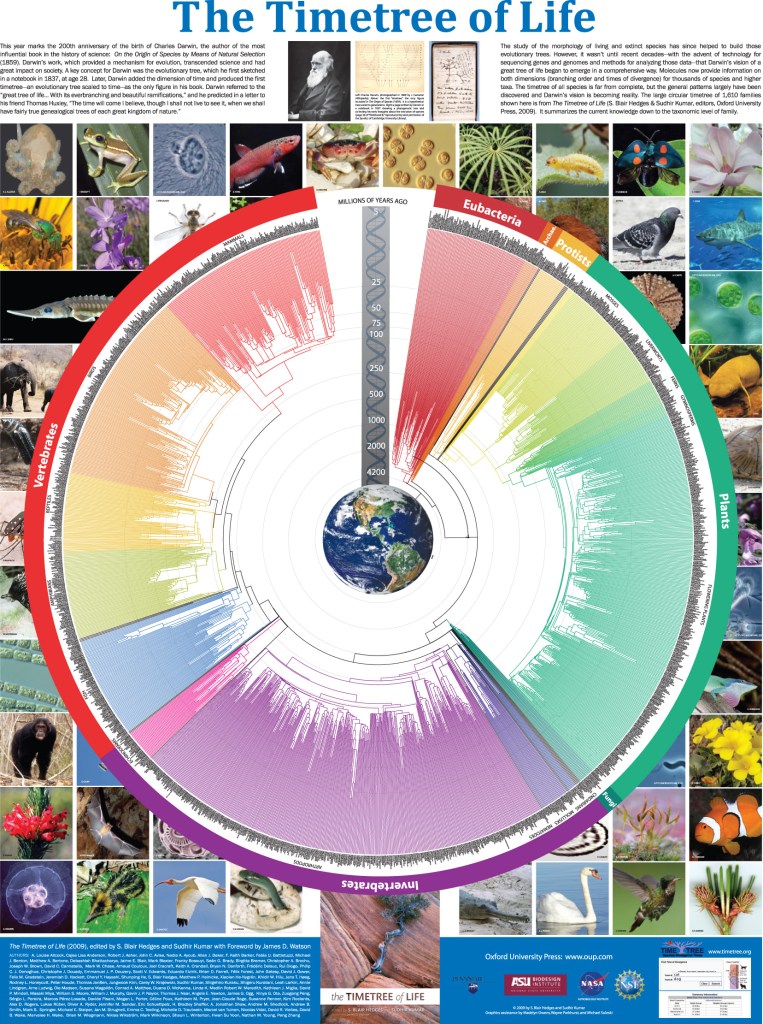
The TimeTree of life, taken from https://timetree.org/book. Image downloaded as a wall poster on their website, and all credits goes to the directors of TimeTree – Dr. Blair Hedges and Dr. Sudhir Kumar.
The utility of phylogenetics
To the layman, phylogenetics and the Tree of Life may sound more like cool trivia. But that is massively underselling the utility of phylogenetics. For one, having access to the evolutionary history of any organism opens a whole new world of research possibilities. How do multiple interacting organisms coevolve? What were environmental conditions like back then that caused species to evolve in a specific direction? Which genes were preserved (or lost), and how does that impact an organism’s function? With sufficient creativity and specialized knowledge, one could ask a seemingly endless number of questions.
Even for ecologists who do not study evolution directly (myself included), phylogeny is something that we always must account for, because the common ancestralism of species implies that species and their characteristics do not operate independently from one another. In my own line of work studying plant functional traits, trait values must be phylogenetically corrected before further statistical analysis can be conducted. Conservationists map out phylogenies of target individuals to ensure that the genetic diversity of endangered species is preserved through conservation programs. Disease ecologists use phylogenetic methods to trace how genes that confer diseases are transferred between and within bacterial lineages. In all these cases, having a solid grasp of species’ intertwined evolutionary histories is the backbone needed to advance other fields of biology and ecology that directly address society’s environmental challenges today.
“Nothing in biology makes sense except in the light of evolution.” (Theodosius Dobzhansky, in his book American Biology Teacher in 1973)
Conclusion
As essential phylogenetics is to modern-day biology and ecology, I believe its significance runs deeper still, even to the layman. This goes into something more fundamental; a trait that lies at the core of human nature – the desire to understand the origins of things, ourselves included.
Think of all the myths and origin stories of the major religions of the world. The three great Abrahamic religions collectively assert that all life on Earth sprung into being due to God’s intervention. In Greek Orphic mythology, the God Phanes begets other gods and goddess whom ultimately bring about life itself. While each mythology and religion may differ on the nature of the divine force that brings about life, each of them assert that life’s history traces back to a single point of origin. Phylogenetics is the scientific approach that draws on the tools of modern biology, ecology, geology and biochemistry to map how all life on Earth converges towards said point of origin. And that’s why news about phylogenetics, speciation and the Tree of Life continue to exert such intellectual appeal till today.
These are just some of my reflections on why phylogenetics matter, even though I don’t see myself doing any research on it anytime soon. Let me know your thoughts as always!





 Forests vs faith
Leave a comment