
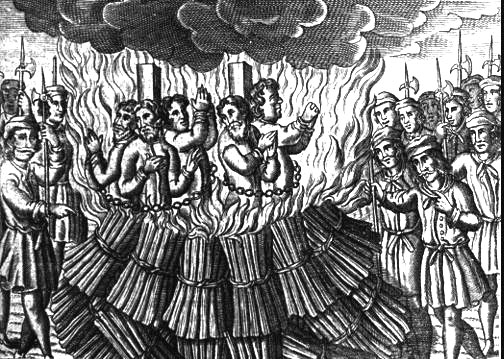
Among all the doctrines within Christianity, the Trinity stands out as one of the most mysterious, yet passionately defended foundations of the faith. Nearly every Christian from any of the mainstream denominations affirm it in one way or another, and theologians across the ages have dedicated countless hours trying to make sense of it. The doctrine of the Trinity has become so deeply embedded in mainstream Christian thought that questioning it openly today is often met with immediate accusations of heresy (but luckily not burning at the stake these days…).
In my previous post, I did a theological quiz called TheoCompass where I covered some major theological questions that define one’s faith. Amongst them is the question on the nature of God and Jesus as follows:
Q: Nature of God – Which best describes your understanding?
A: Unitarian (Father alone is God): Jesus is subordinate, a created being, or a great prophet, but not God in the same sense as the Father.
Traditional Christian doctrine affirms that while the Father, Son (Jesus) and the Holy Spirit are all distinct entities, each of them is wholly God, coequal and coeternal. How this is possible has remained a mystery since it does not follow conventional logic, and theologians have openly claimed that it is impossible to grasp it fully within human means. Take St. Augustine for example:
But this Trinity, as he shows, is here seen by us as by a mirror and in an enigma, in that it is seen by means of the image of God, which we are, as in a likeness that is obscure and hard of discernment. – On the Trinity, Book XV by St. Augustine
Bewilderingly, for such a profound, mysterious and murky doctrine, Christians vehemently defend it despite not fully understanding it. Nevertheless, this lack of comprehension has not stopped Christians (especially apologists) from pushing out poor arguments to support traditional Trinitarian doctrine or mischaracterizing opposing arguments. Even scholarly developments have not stopped this onslaught of poor arguments online.
What I hope to accomplish in this post is to consolidate and counter some of the worst of these arguments to encourage readers, and especially believers, to reflect on how they came to accept one of the most foundational, yet mysterious claims of Christianity. Rather than simply parroting a doctrine taught by one’s pastor/teacher, I hope readers of this post can embrace an open mind to construct their own thought process in order to better argue for (or against) the Trinity.
Claim 1: Jesus must be God because Jesus does what only God can do
When Jesus saw their faith, he said to the paralytic, “Child, your sins are forgiven.”…Which is easier: to say to the paralytic, ‘Your sins are forgiven,’ or to say, ‘Stand up and take your mat and walk’? But so that you may know that the Son of Man has authority on earth to forgive sins”—he said to the paralytic— “I say to you, stand up, take your mat, and go to your home.” (Mark 2:5;9-11 NRSVUE)
Arguments used to support Jesus’s equality with God often turn to the gospels, where Jesus was said to do many miracles such as healing the paralytic (Mark 2; see above) and raising a dead girl (Matthew 9:18-26). These are clearly supernatural feats reserved for the divine, and thus it is very easy for the modern reader to jump to the conclusion that Jesus must therefore be God.
This, however, fails to consider the events outside of the gospels, such as in the OT. For example, Elijah in 1 Kings 17 raises the widow’s son in Zarephath. Does that mean Elijah is God too? Obviously no, and the narrative makes it clear how Elijah is able to achieve such a feat – by invoking the divine name of God (the Father). Applying that same logic to the girl in Mark 5 (Matthew 9:18-26), Jesus’s miraculous feat can be achieved via invoking divine authority and power from the Father as well. In fact, that is exactly what Jesus does to heal the paralytic man in Mark 2 “But so that you may know the Son of Man has authority on Earth to forgive sins”. Similarly, Jesus often prays (presumably to the Father) before accomplishing many other miraculous feats, including the feeding of the 5000 (Mark 6) and exorcising the evil spirit out of a boy (Mark 9:29).
Throughout the OT, prophets and kings have been shown to either 1) invoke God’s name to do miracles, or 2) be conduits to channel God’s power and authority into the world. It is through said process that people could do things that were thought to be reserved only for the divine, including the forgiveness of sins (notice Jesus never said He was the one who forgave the paralytic’s sins), winning impossible battles against foreign nations and even raising the dead. Thus, within the context of Jesus’s time, while miracle-working is an indication that one has divine authority, it isn’t a sufficient indication on its own that one is literally coequal to God the Father. After all, at the end of John’s and Mark’s gospels, Jesus passed on to His apostles the authority to forgive sins and heal the sick. Are we to think the apostles became God too?
Jesus said to them again, “Peace be with you. As the Father has sent me, so I send you.” When he had said this, he breathed on them and said to them, “Receive the Holy Spirit. If you forgive the sins of any, they are forgiven them; if you retain the sins of any, they are retained.” (John 20:21-23)
And these signs will accompany those who believe: by using my name they will cast out demons; they will speak in new tongues; they will pick up snakes, and if they drink any deadly thing, it will not hurt them; they will lay their hands on the sick, and they will recover.” (Mark 16:17-18 NRSVUE)
Claim 2: Jesus is referred to as God directly
Throughout the NT, Jesus has been referred to in many places as “God”. Surely this must mean Jesus is God right?
In the beginning was the Word, and the Word was with God, and the Word was God. (John 1:1 NRSVUE)
Simeon Peter, a servant and apostle of Jesus Christ, To those who have received a faith as equally honorable as ours through the righteousness of our God and Savior Jesus Christ (2 Peter 1:1 NRSVUE)
And we know that the Son of God has come and has given us understanding so that we may know him who is true; and we are in him who is true, in his Son Jesus Christ. He is the true God and eternal life. (1 John 5:20 NRSVUE)
To unpack why this argument doesn’t quite hold water, one cannot simply quote-mine individual verses from the NT to show Jesus’s equality with God the Father. For example, it is true indeed that the author of the gospel of John seems to think in a couple of places that Jesus is divine (or perhaps equal to God in some sense). The verses often quoted include John 1:1, John 8:58 (invoking the words ἐγώ εἰμι, or “I AM”); all of which point towards divinity (but not necessarily coequality with the Father, read on).
Yet, much of the same gospel shows that Jesus was sent by the Father (John 20:21), does works as instructed by the Father (John 14:31a) and is overall subservient to the Father (John 14:28). These align well with the concept of Jesus receiving divine authority as seen in Matthew 28:18. I would argue the reason why Jesus could receive divine authority is because a superior entity, such as the Father, granted it to Him. In contrast, if Jesus was already coequal to God, there would have been no need for Him to distinguish Himself from the Father in terms of authority, nor it would make sense for Him to be exalted even higher, such as in the case of the famous poem in Philippians 2:9-11.
How then can one make sense of other verses that claim “one-ness” with the Father, such as John 10:30? This is where English translations do us a disservice – “one-ness” here in this case do not refer to a literal “one-ness”, but a unity in function (John 17 uses the same term but explains the unity in function more clearly). To explicitly claim “one-ness” in a different sense, one would need to use a different Greek term instead, such as ὁμοούσιος (Homoousios). Curiously, the latter term (supposedly popularized by Origen of Alexandria, but exact origins within Christianity remains unclear) is exactly the spark that led to the development of the Trinitarian framework debated at the Council of Nicaea. That is why modern scholars today argue that the Trinity is a post-biblical philosophical framework.
The Father and I are one (ἕν).” (John 10:30 NRSVUE)
The glory that you have given me I have given them, so that they may be one (ἕν), as we are one (ἕν), I in them and you in me, that they may become completely one (ἕν), so that the world may know that you have sent me and have loved them even as you have loved me. (John 17:22-23 NRSVUE)
Finally, opponents often argue that Jesus must be coequal with God, or else referring to Him as “God” will be blasphemous. For example, Thomas called Jesus “my Lord and my God” (John 20:28). Again, this weak argument is fueled by quote-mining individual verses, but collapses when tested against the entirety of Scripture. For example, Manoah met the angel of the Lord and thought he would die for having seen God (Judges 13:21-22). Similarly, that same angel calls himself (or Himself?) God when encountering Moses at the burning bush (Exodus 3:6). Consequently, we can see other entities being referred to as “God” without literally sharing a “being” with God the Father. For a better understanding on how entitles can possess divine agency and the divine name of God, I would recommend this explanation by Dan McClellan. Trying to claim the divine name without authorization from God is highly blasphemous, which explains why Jesus’s opponents tried to stone Him in the gospel of John.
He said further, “I am the God of your father, the God of Abraham, the God of Isaac, and the God of Jacob.” And Moses hid his face, for he was afraid to look at God. (Exodus 3:6 NRSVUE)
If Jesus is God but not GOD-GOD, what could He be then? This is where one needs to look beyond the bible to properly understand ancient conceptions of divinity. In ancient Greco-Roman times, the divine realm was not a simple binary, but a continuum of divine and semi-divine entities and hierarchies. Hence, when one reads of Jesus being referred to as God, it is important to question “God in what sense”? God the Father? God as an angel (see Exodus 3:6 and Gal 4:14)? A mini “god” (John 10:33-36)?
…though my condition put you to the test, you did not scorn or despise me but welcomed me as an angel of God, as Christ Jesus. (Galatians 4:14 NRSVUE)
“We are not stoning you for any good work,” they replied, “but for blasphemy, because you, a mere man, claim to be God.” Jesus answered them, “Is it not written in your Law, ‘I have said you are “gods”’? If he called them ‘gods,’ to whom the word of God came—and Scripture cannot be set aside — what about the one whom the Father set apart as his very own and sent into the world? Why then do you accuse me of blasphemy because I said, ‘I am God’s Son’? (John 10:33-36)
As this post is getting too long, I will continue addressing more bad arguments in my next post on the theology track.







Leave a comment