

It was 1859 when Charles Darwin first published his seminal work “On the origins of species”, introducing the ideas modern biology takes for granted today – the theory of evolution and speciation. In his work, much of his observations were drawn from his travels on the HMS Beagle, surveying species from the South American mainland and the Galapagos. Anyone who has taken a high-school biology course would be familiar with the picture of Darwin’s finches.
Unknown to many, there was another man who stumbled upon the theory of evolution halfway across the globe at about the same time as Darwin. Meet Alfred Russel Wallace – a naturalist who started his travels from the South Americans and eventually headed off to the Malay Archipelago to survey animal populations from modern-day Indonesia, Papua New Guinea and tropical Australia. As his work forced him to be located far away from his colleagues in the UK, he was not heavily involved in the publication process that led to Darwin’s seminal work. Nevertheless, his contributions to the theory of evolution remains significant, and his legacy lives on in the form of the Wallace line – an imaginary boundary that split the Malay Archipelago into two distinct faunal bioregions (the line runs between Bali and Lombok today).
As one can see, the tropics were integral to the inspiration of evolutionary thought, even 200 years ago. Considering how important the tropics were, it is bewildering to see it so vastly underrepresented in much of modern ecology and biology today.
Underrepresentation of the tropics in ecology
The underrepresentation of the tropics is a very real issue that runs rampant through almost all of ecology. Pick any global meta-analysis of ecological variables – be it plant functional traits, insect populations or soils, and look at the distribution of observations in these studies. Here, I picked three studies – pay attention to the number of sites located within versus outside the tropics.

Sites containing available fine root traits of plant species used in a meta-analysis by Freschet et al. (2017) – Fig. 1.
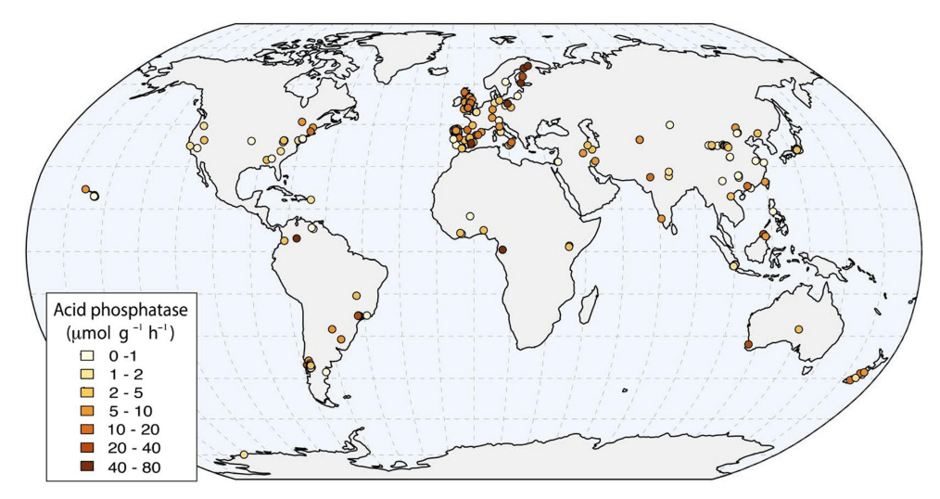
Sites containing observations of soil acid phosphatase used in a meta-analysis by Margalef et al. (2017) – Fig. 1.
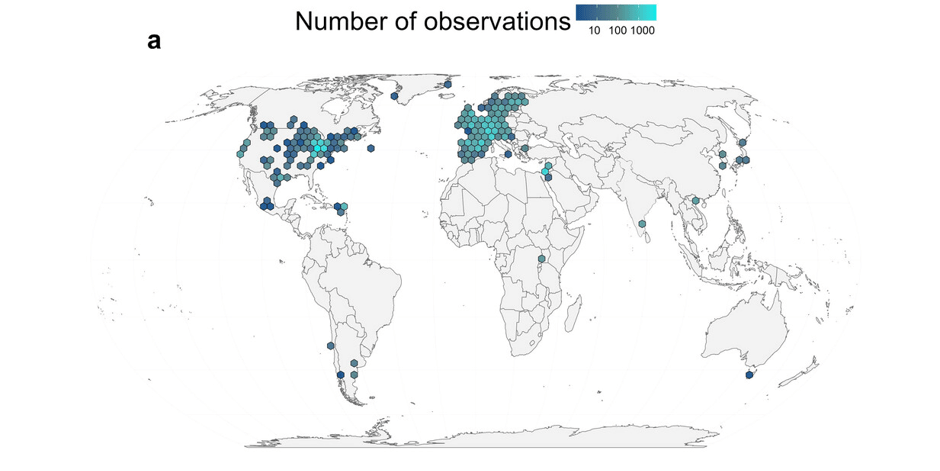
Number of observations of butterflies reported in Schmucki et al. (2026) – Fig. 1.
Explaining the cause of said underrepresentation isn’t difficult. For one, due to a complex mix of historical reasons, the tropics tend to be more underdeveloped than their richer counterparts in temperate zones – think the US, UK and other rich European nations. This meant that for a long term, only rich nations such as these could embark on long voyages to systematically survey biodiversity to fuel scientific thought in ecology. Furthermore, riding on the back of the Scientific Revolution in the 16th century, Europe became a powerhouse in scientific thought, which established a system where scientific ideas could be refined, tested, published and disseminated*. To my knowledge, no equivalent system existed, even in other highly developed civilizations in that era (e.g. the Ottoman empire).
*The oldest English ecology/biology scientific journal is the Philosophical Transactions of the Royal Society B: Biological Sciences, established in 1665 by the Royal Society in London.
This is not to say that ecology didn’t exist in other countries back then. Rather, ecology as a scientific discipline was likely not formalized in other nations till recently. I would venture to guess that back then, ecology existed mainly in the form of traditional ecological knowledge (TEK) in most of the world rather than a formal scientific discipline unique to Europe. For better or worse, rich, temperate nations became the leaders in scientific thought in the modern era, and the world’s best institutions in ecology are all found in places such as the US and Europe, far away from the tropics.
My post today isn’t to elaborate on the causes or the problems of the underrepresentation of the tropics in ecology – plenty of people brighter than me has contributed plenty to that discussion. Because so many of our modern ecological theories were developed by temperate researchers observing temperate systems, I wondered what if the world could turn back the clock and make the tropics the center of ecological thought? How would our ecological theories look like then?
A tropics-centric discipline in another timeline?
Take for example the question of why are there so many species in the tropics? One of the central theories in ecology is the competitive exclusion principle, where two species cannot stably coexist if they share identical niches. In other words, species are forced to differentiate from one another in order to coexist.
However, such a theory doesn’t quite square with the tropics where thousands of species coexist within a single forest site. While there have been more recent hypotheses to explain the coexistence of species in species-dense environments (e.g. the Janzen-Connell hypothesis), we still don’t quite understand what drove and maintains the exceptional high concentration of species in the tropics beyond the conducive temperatures and precipitation that favors most of life.
Implicit to the original question is the fact that temperate regions have a baseline “normal” number of species, and it is the tropics that is the outlier in terms of biodiversity. What if the question was flipped on its head instead? Imagine if ecology started 200 years ago from the depth of Amazonia instead, and researchers saw just how little tree species dominated the temperate forests of North America. Now, the question becomes “Why are there so little tree species in the temperate zones? What’s stopping speciation in the temperate regions?” We know from examining temperate plant and animal species that many can and have evolved their own adaptations to thrive in cooler, drier regions. Yet, why didn’t more species develop from that process?
Here’s another example. Many tropical forests are known to thrive on surprisingly infertile soils despite being highly productive belowground. How? This has been a key question among biogeochemists and tropical ecologists, who have only recently started paying more attention to the strategies in how plants overcome nutrient limitation belowground in these systems. Yet, if we were to flip the question, one could ask “why aren’t temperate forests more productive despite having fertile soils?” In such a world, we might postulate that soil nutrient limitation isn’t the biggest factor in driving plant productivity, and focus on abiotic factors like temperature. Or perhaps we might observe that soil fertility is inversely related to tree species abundances and conclude (erroneously?) that high fertility is detrimental for plant biodiversity. Who knows?
Conclusion
As someone who did his PhD in ecology in the tropics, I sometimes wonder what if in another timeline, everything started off in the tropics. How would ecology have evolved (hehe) as a discipline then? One could only dream…
At the same time, I don’t know if the scientific field has matured enough where we can open ourselves up to asking these fundamental questions in a different light. So much of science is built on the works of our predecessors, and going against the currents of past scientific consensus is always difficult – unless innovation comes naturally to you (not for me). Maybe someday when we have run out of questions to ask, someone would take the bold next step and ask instead, “why are there so little tree species in the temperate zones?”
Perhaps someday we will have a new generation of ecologists (maybe coming from an underrepresented country in Africa?) who are able to view the world in a fresh light and propose refreshing new theories to explain ecological phenomena from a tropics-centric perspective. I don’t know if by then, I will still be doing ecological research (or maybe I’ll be six feet under by then). But it’ll be an exciting time for ecology if it does happen, and I look forward to it someday.







Leave a Reply